
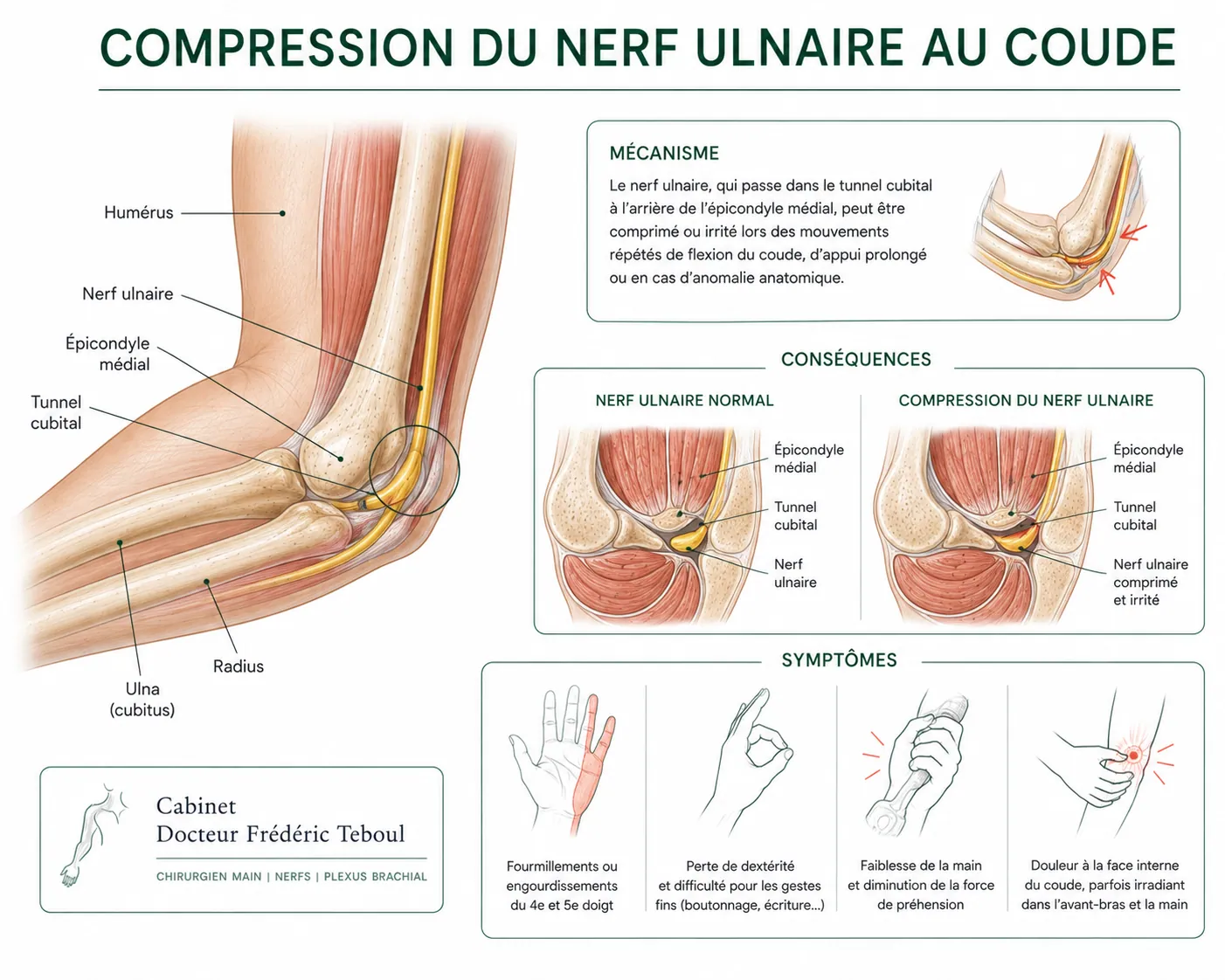
Ulnar nerve compression at the elbow — its causes, its symptoms (tingling in the last two fingers, loss of strength), and its diagnosis — is described on a dedicated page. This page addresses when to operate, and the question that then arises: should the nerve simply be released, or also moved? It lays out both techniques and, above all, the factor that decides between them.
Why operate, and why this nerve is unusual
On the inner side of the elbow, the ulnar nerve passes through a narrow channel, just behind the small bony bump you sometimes knock — the medial epicondyle. There it is superficial, pressed against the bone, and stretched with every bend of the elbow. When it is compressed there for a prolonged time, tingling and weakness set in; without treatment, advanced damage can leave muscle wasting in the hand that is hard to reverse. Surgery aims to relieve the compression before that stage.
Two strategies: release in place, or move the nerve
Faced with this compressed nerve, the two main techniques respond differently — and understanding their logic is the key to the choice.
Simple neurolysis
Decompression in situ opens the tunnel and frees the nerve while leaving it in its natural position. It is the lightest procedure: a small incision, no relocation of the nerve, rapid recovery.
Anterior transposition
It frees the nerve and then moves it in front of the medial epicondyle, into a more direct path where it is no longer stretched or exposed against the bone. It is tucked either under the skin or under a muscle.
One frees without relocating; the other frees and relocates. The choice does not come down to preference, but to how the nerve behaves.
The key point: neither is superior overall
What the literature actually says
For the usual compressions, the two techniques give comparable results. The most rigorous studies show no clear superiority of transposition over simple release.
Because simple release is a lighter procedure, it carries fewer complications from the surgical approach, which often makes it the preferred first-line option in straightforward cases.
In other words, “moving more” is not “doing better.” Adding a transposition to a simple compression does not guarantee a better result, but it makes the procedure more involved. The right instinct is not to transpose everything, but to transpose when it is justified.
This is the most important message on this page, and the one where honesty takes precedence over any habit.
The deciding factor: nerve stability
Since the two techniques are generally equivalent, how do you decide? By one precise factor, which is at the heart of modern expertise: does the nerve stay in place, or does it move?
A stable nerve → release it in place
If it stays quietly in its widened tunnel when the elbow bends, moving it adds nothing: simple neurolysis is enough.
An unstable nerve → transpose it
If the nerve tends to slide, to dislocate over the bone during flexion — spontaneously or after release —, leaving it in place would expose it to rubbing and becoming compressed again. Moving it forward, into a protected path, then becomes justified. This instability may be known before surgery, or found during it, by testing the nerve with the elbow bent.
Local causes and revisions
Transposition also has its place in local causes (bony callus, the aftermath of a fracture, deformity) and in revisions after a first release has failed.
Subcutaneous or submuscular: a choice within the choice
When a transposition is decided on, the nerve can be tucked under the skin or under a muscle. The two variants give comparable results; the subcutaneous route, which is simpler, carries slightly fewer complications, while the submuscular route gives the nerve thicker coverage, useful in certain situations (a thin patient, a revision). Here again, the choice is tailored to the individual.
Outcomes and honesty about recovery
When properly indicated, surgery on the ulnar nerve at the elbow halts the progression and relieves most patients. But one message must be clear: it is all the more effective the earlier it is done. Tingling and pain often subside well; strength and fine sensation recover more slowly, and long-standing damage, with established muscle wasting, may not recover fully. Operating before the stage of muscle wasting is therefore decisive.
An honest point about follow-up: after a simple release, if symptoms persist because of unrecognized instability, a secondary transposition remains possible — all the more reason to assess stability carefully from the outset.
Summary points
These points sum up the expertise: releasing is enough most of the time; moving the nerve is reserved for unstable nerves and special situations. The anatomical pitfalls should not be overlooked — snapping triceps, muscle hypertrophy, a medial bony spur, congenital malformations, abnormalities of the medial epicondyle.
Frequently asked questions
Glossary
A nerve of the upper limb that passes at the elbow behind the medial epicondyle; controls part of the hand.
Compression of the ulnar nerve at the elbow, the second most common nerve compression.
Release of the nerve while leaving it in place, without moving it.
Moving the nerve in front of the elbow, into a shorter, protected path.
A bony prominence on the inner side of the elbow, behind which the ulnar nerve passes.
The nerve's tendency to slide out of its groove during flexion; the main indication for transposition.
References
Sources supporting the facts presented.
Simple Decompression Versus Anterior Transposition of the Ulnar Nerve for Cubital Tunnel Syndrome: a meta-analysis. J Hand Surg — no statistically significant difference between simple decompression and transposition; cubital tunnel syndrome is the 2nd most common compressive neuropathy of the upper limb.
Anterior Transposition Compared with Simple Decompression: meta-analysis of randomized controlled trials. J Bone Joint Surg Am, 2007 — comparable clinical results between the two approaches in idiopathic cases.
Subcutaneous versus Submuscular Anterior Transposition: systematic review and meta-analysis — comparable effectiveness of the two variants; fewer adverse events with the subcutaneous route.
Ulnar nerve stability-based surgery for cubital tunnel syndrome — decision based on the nerve's intraoperative stability; patients with instability or subluxation benefit from transposition.
Higher Revision Rates With In Situ Decompression as Compared to Ulnar Nerve Transposition — a signal of a potentially higher revision rate after simple decompression over the long term; data to be confirmed by prospective trials.
Page reviewed and approved by Dr Frédéric Teboul, hand, brachial plexus and peripheral nerve surgeon, member of the Académie Nationale de Chirurgie.
Last updated: August 20, 2026
Disclaimer. This page is intended to provide information about surgical techniques. It is not a substitute for a consultation. Ulnar nerve damage warrants an early specialist opinion, since recovery is better before the stage of muscle wasting.
Author of this publication
Every piece of content is signed by its author and reviewed before publication.
 Author
Dr Frédéric Teboul
Surgeon specializing in peripheral nerves
Author
Dr Frédéric Teboul
Surgeon specializing in peripheral nerves