
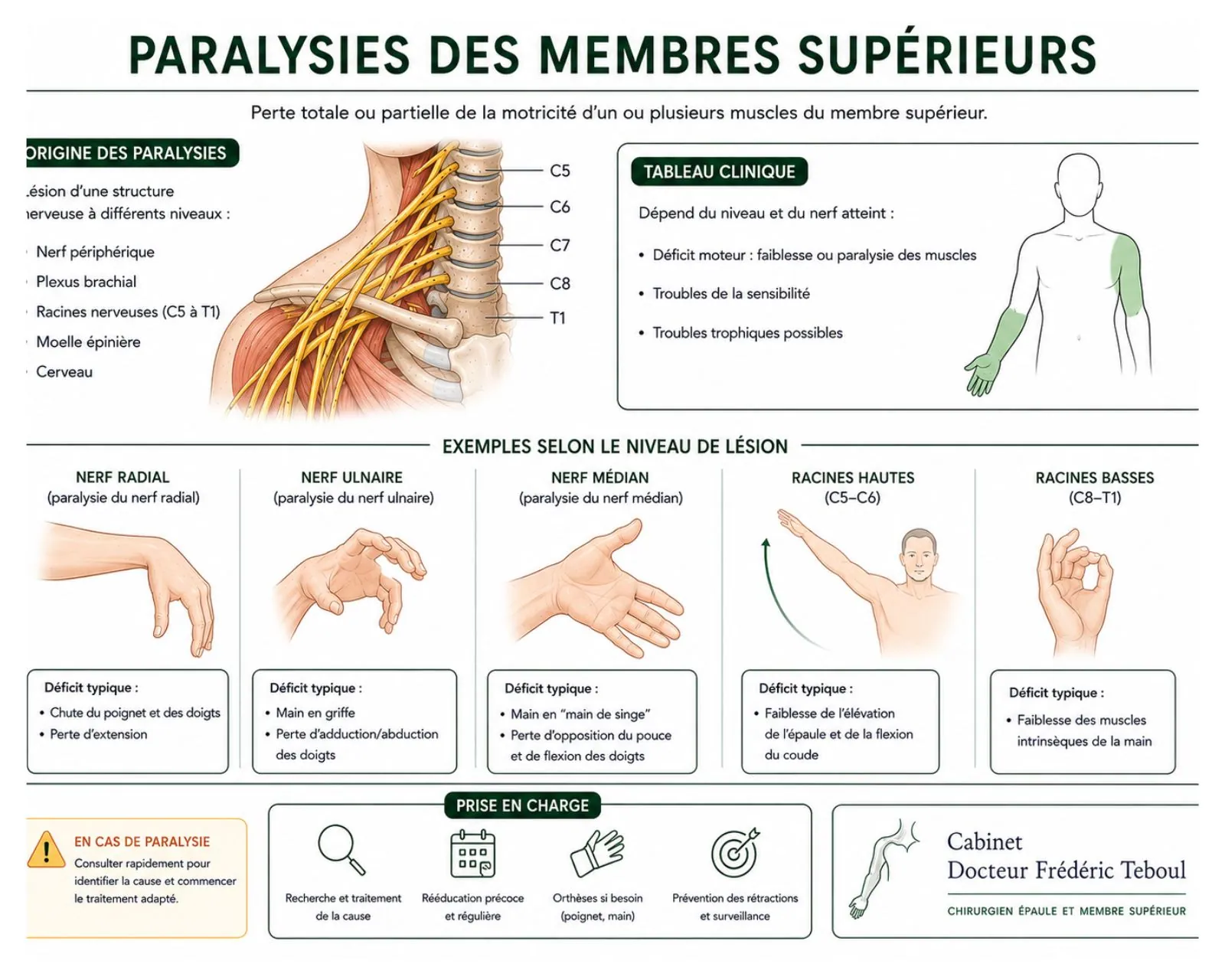
An arm that no longer lifts, a hand that hangs, fingers that no longer straighten, a pinch that has vanished, an ankle that drags, toes that no longer lift. Whether it follows an accident, prolonged pressure, or has no obvious cause, palsy of a limb is always alarming — and raises one question before all others: where does it come from?
This article serves as an entry point. It explains how palsy of the arm or ankle is read, why pinpointing exactly where the problem lies is decisive, and toward which kind of care each situation points. It is the thread that connects all the nerve problems of the limbs.
A palsy is not a diagnosis: it's a question of level
The upper limb is controlled by a long nerve pathway: from the spinal cord, at the level of the neck, the nerves travel as a network — the brachial plexus — then split into large individual nerves that run down to the hand.
The principle that governs the whole article
The deficit depends on where the injury is. A palsy does not, on its own, tell what happened or what can be hoped for. It is by locating the level — near the spinal cord, on the plexus, or on an isolated nerve lower down — that we understand the deficit, estimate the outlook, and choose the treatment.
The same complaint, “my arm, my leg is paralyzed,” covers radically different situations depending on that level.
The main levels of injury
High up: the brachial plexus
When the injury sits near the spinal cord, on the nerve network of the neck, it can affect large portions of the limb at once — shoulder and elbow, or hand, or the whole arm. This is the domain of brachial plexus injuries, most often after a violent trauma. They are the most complex, and their outlook depends closely on how quickly they are managed.
These injuries are the subject of a dedicated article, because they follow their own rules — notably the crucial importance of the time factor. This is Dr Teboul's area of highest specialization.
Lower down: an isolated nerve
When the injury affects a single nerve of the arm, lower along its course, the deficit is more focused: it matches precisely the territory of that nerve. Three main nerves may be involved, each producing a recognizable picture.
Isolated nerve palsies of the arm
The radial nerve: “wrist drop”
The radial nerve controls extension — lifting the wrist and fingers. Its injury produces a very characteristic sign: wrist drop, a wrist that hangs and cannot be lifted, with fingers that no longer straighten.
“Saturday night palsy”: hidden good news
The best-known cause is compression of the nerve against the arm bone during prolonged pressure — an arm left too long resting on a chair back or bent under the head during deep sleep. Hence the vivid nickname “Saturday night palsy.”
The good news: in this simple-compression form, the nerve is not severed, only “asleep.” Recovery is most often complete, on its own, over a few weeks to a few months. It is the perfect example of a palsy that looks dramatic but has a good outlook — provided the cause has been correctly identified.
The radial nerve can also be injured during a fracture of the arm bone, which it runs alongside closely. The approach is then different and depends on the context of the fracture.
The median nerve and the ulnar nerve
These two nerves mainly control the hand. Their most frequent problems are not sudden palsies but progressive chronic compressions, which are the subject of dedicated articles on this site:
The median nerve is most often compressed at the wrist — this is carpal tunnel syndrome, with tingling and, at an advanced stage, weakness of the thumb pinch. See the carpal tunnel article.
The ulnar nerve is most often compressed at the elbow, causing tingling in the last two fingers and, over time, a loss of hand strength. It can also be compressed at the wrist: see the Guyon's canal article.
These nerves can also be injured acutely, by a wound or a fracture, producing a true palsy of their territory.
Recognizing what is not an arm-nerve problem
An important point, because it changes everything: not every palsy of an upper limb comes from a problem with the nerves of the arm. A more central origin — at the neck (a nerve root compressed by the spine) or the brain (a stroke) — can also show up as arm weakness.
A sign that calls for emergency care
Sudden arm weakness, especially if it comes with other signs — trouble speaking, a drooping face, weakness of a leg, on the same side — may be the sign of a stroke, which is an absolute life-threatening emergency.
In that case, do not wait: call emergency services immediately. This kind of palsy does not fall under nerve surgery, but under a different, emergency care.
It is also the job of the work-up to sort this out: to distinguish what comes from the arm itself from what comes from higher up (the central nervous system: brain and spinal cord).
The work-up: locate, then refine
The approach is always the same, whatever the suspected level:
It is central: by testing precisely which muscles are weak and which areas have lost their sensation, we trace back to the affected nerve or level. It is the first and most important step.
It confirms the level of the injury, gauges its severity and how long it has been present, and follows any recovery.
Ultrasound and MRI visualize the nerve and look for a compression, a rupture, or a local cause (scar tissue, a mass).
The main treatment paths
Depending on the level and the mechanism, care follows one of these lines:
Monitor and rehabilitate, when spontaneous recovery is possible — as in Saturday night palsy. Rehabilitation keeps the limb supple in the meantime.
Release the nerve when it is compressed — release at the carpal tunnel, at the elbow, at Guyon's canal.
Repair or reconstruct, when the nerve is severed or a root is avulsed: graft or nerve transfer, as part of specialized surgery.
The most frequent problems
Brachial plexus palsy after a motorcycle accident; deltoid palsy (axillary nerve), spontaneous or after shoulder surgery; radial nerve palsy after a fracture of the humerus; ulnar and median nerve palsy around the elbow from muscular arcades; long thoracic nerve palsy with spontaneous scapula alata; trapezius muscle palsy after neck surgery (lymph node biopsy); constrictive neuropathies; common fibular nerve palsy after a severe knee sprain or after surgery; femoral nerve palsy, most often after pelvic surgery or an anterior-approach hip replacement.
One principle runs through all these situations: when the nerve is injured and must be repaired, time matters. A muscle deprived of its nerve for too long recovers poorly. That is why a palsy that does not improve should be assessed without too much delay, even if the final decision is sometimes to watch and wait.
The guidance table
This table is for guidance only: only an examination can establish the true level of the injury and its cause.
Rehabilitation, in every case
Protocols are decided case by case: visit our knowledge center to discover specific, real-world cases.
Frequently asked questions
Glossary
Total or partial loss of control of one or more muscles.
A network of nerves, arising from the spinal cord at the level of the neck, that controls the entire upper limb.
The nerve for wrist and finger extension; its injury produces “wrist drop.”
The nerve most often compressed at the wrist (carpal tunnel).
The nerve most often compressed at the elbow.
Compression of the radial nerve from prolonged pressure; a good outlook, often reversible.
A test that measures the activity of nerves and muscles to locate an injury.
References
Approach to differentiating lesions (nerve root, plexus, and peripheral nerve). 2025 — the approach rests on localization: root, plexus, or peripheral nerve, each producing a distinct motor and sensory pattern
Wrist Drop. StatPearls. 2026 — radial nerve injury in the humeral groove (“Saturday night palsy”) produces wrist drop; acute compressive neuropathies have an excellent outlook
Saturday Night Palsy (case report and review). Cureus. 2021 — radial nerve neurapraxia from prolonged compression; near-universal recovery by 6 months
Clinical Features of Wrist Drop Caused by Compressive Radial Neuropathy. 2014 — the precise location of the radial injury determines the picture and the approach
A Structured Approach to the Diagnosis of Peripheral Nervous System Disorders. Continuum. 2021 — central signs (stroke) call for distinct, urgent management
Isolated Radial Nerve Palsy Following Humerus Fracture — radial nerve injury complicates 5–10% of humeral shaft fractures
Epidemiology of upper-limb nerve palsies in hand surgery practice — reference to be completed
Recovery times by nerve and by mechanism — reference to be completed
Reviewed and approved by Dr Frédéric Teboul, hand, brachial plexus, and peripheral nerve surgeon, member of the Académie Nationale de Chirurgie.
Last updated: August 20, 2026
Disclaimer. This article is intended to inform and guide. It is not a substitute for a consultation. Sudden arm weakness combined with trouble speaking or a drooping face means you should call emergency services immediately.
Author of this publication
Every piece of content is signed by its author and reviewed before publication.
 Author
Dr Frédéric Teboul
Brachial plexus and peripheral nerve surgeon
Author
Dr Frédéric Teboul
Brachial plexus and peripheral nerve surgeon