
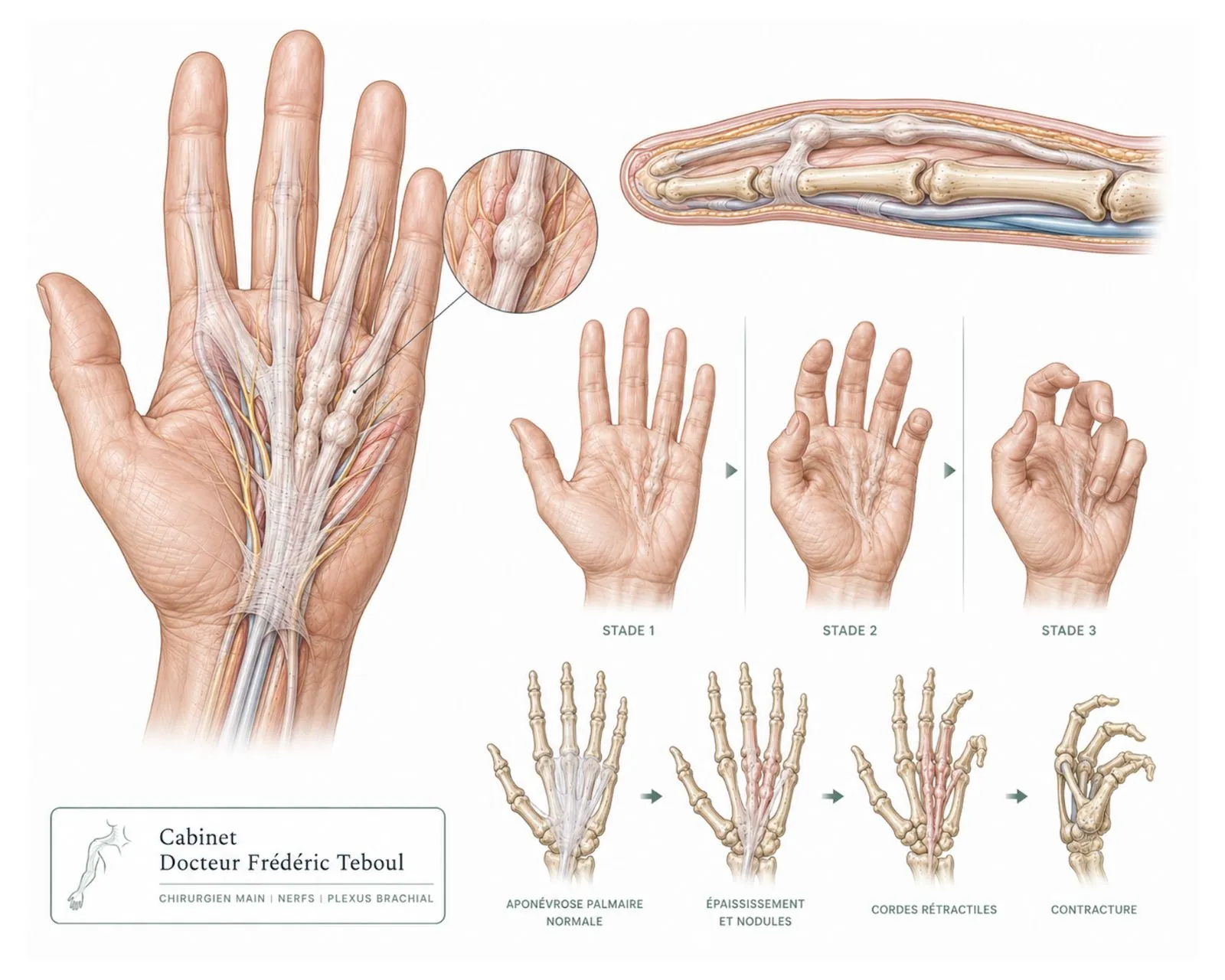
A small, firm nodule in the palm that appeared a few years ago. Then a cord under the skin. And today, a finger that no longer straightens fully, a hand that no longer lies flat on the table.
Dupuytren's disease often causes more worry than pain. This article explains what it really is, when treatment becomes worthwhile, and why the word “recurrence” does not mean here what people usually assume.
What is happening in your hand
Beneath the skin of your palm lies a strong fibrous membrane called the palmar fascia. Its role is to anchor the skin so you can grip objects without it sliding.
In Dupuytren's disease, this membrane thickens abnormally. Firm nodules appear, attached to the skin. They spread and join together to form cords that slowly tighten and pull the fingers toward the palm.
Three misconceptions to clear up right away
It is not your tendons. The disease affects the fascia, a membrane that lies above them. The flexor tendons are not involved. This is why the hand can be reopened without touching the fingers' flexion system.
It is not a cancer. It is a benign overgrowth of fibrous tissue, with no malignant, tumoral nature.
It is usually not painful. The nodules are most often painless. It is the functional impairment, not pain, that leads people to seek care.
How it progresses
The disease progresses in stages, over several years, and its pace varies widely from one person to another.
It most often affects the ring finger and the little finger, and involvement is frequently bilateral, though the two hands do not progress at the same pace.
Severity is assessed by adding up the degrees of flexion the finger can no longer straighten out — the extension deficit. The Tubiana classification, named after the French surgeon who described it, sorts these deficits into stages.
The test you can do at home
Place your hand flat on a table, palm down.
If it lies down completely, with no finger lifting off, the disease is not yet affecting your function. If one or more fingers stay raised, it is a sign of an established contracture — and the time to talk to a hand surgeon.
This simple test has long been used as a practical benchmark. It does not replace a proper assessment, but it gives an objective starting point.
Who is affected, and why
Dupuytren's disease is common, but very unevenly distributed. Prevalence estimates vary widely depending on the populations studied and the definitions used, which calls for caution with the figures in circulation.
The best-established associated factors:
The disease rarely appears before age 40.
Men are affected considerably more often, and generally earlier.
A hereditary component is well documented. Having an affected relative raises the risk without making it a certainty.
The disease is markedly more common in Northern European populations.
Diabetes, smoking, and alcohol consumption are among the reported associations. Epilepsy is not in itself a risk factor: the link came from the barbiturates once taken to treat it, drugs that are no longer prescribed today.
The connection is frequently raised by patients, but remains debated in the literature.
A useful clarification. These factors are statistical associations, not individual causes. None of them, taken alone, explains why a given hand develops the disease. There is nothing you did to bring it on.
The case of more aggressive forms
Some profiles progress faster and recur more: onset before age 40, strong family history, involvement of both hands, and the presence of sites outside the palm — on the soles of the feet, or on the back of the finger joints.
This concept has a name in hand surgery and a direct consequence: it does not change the treatment offered, but it changes what you should be told about the risk of recurrence. It deserves to be identified beforehand, not afterward.
What it should not be confused with
A finger that no longer straightens is not always Dupuytren's.
Trigger finger causes a catch that releases suddenly, often with a snap, and the finger can still be straightened passively. In Dupuytren's, the contracture is permanent and there is a palpable cord. See the trigger finger article.
Stiffness after an injury or a burn can produce a similar picture, without nodule or cord.
A nerve disorder can produce a finger deformity of a completely different origin.
The diagnosis remains clinical: palpating the nodules and cords, the tethering of the skin, and the fixed nature of the contracture are usually enough. Ultrasound and MRI are not needed in typical cases.
The treatments actually available in France
This is the area where much of the information online is now outdated, including on reputable sites.
Collagenase injections are no longer available in Europe
This injectable treatment, which chemically dissolved the cord, was long among the options. Its marketing authorization was withdrawn in the European Union on March 1st , 2020, at the request of the company that marketed it.
This withdrawal was not driven by a safety or efficacy concern: it was a business decision by the manufacturer, which also pulled the product from the Asian and Australian markets.
In practical terms: if you read that collagenase is an option, that information does not apply to France. The Dutch guidelines, published shortly afterward, also judged the level of evidence for it to be low to very low.
In practice, then, three paths remain.
1. Do nothing — and sometimes that is the right decision
As long as there are only nodules, without bothersome contracture, monitoring is justified. Some nodules stay stable for years.
Two points that are often misunderstood: neither extension splints nor physical therapy alone has been shown to prevent cords from progressing or to avoid a procedure. They can help maintain mobility, but they do not slow the disease.
2. Percutaneous needle aponeurotomy
The principle: dividing the cord through the skin with a needle, under local anesthesia, without opening the hand. The correction is immediate and the return to activity quick.
The Dutch guidelines set out two important conditions:
It is suited in particular to a relatively young patient with a palpable cord who wants a minimally invasive treatment and accepts a higher recurrence rate.
It is not indicated when there is no palpable cord.
This second point is worth remembering: the technique acts on a cord. On a nodule alone, there is nothing to divide.
3. Surgery
Partial fasciectomy — the surgical removal of the diseased segments of fascia — is the first-line treatment according to the Dutch guidelines. Dutch 2022 It is the standard technique for established or recurrent forms.
In situations where the skin itself is involved, or after several recurrences, a more extensive technique combining skin removal with or without a skin graft may be offered: the risk of recurrence is lower, at the cost of longer healing.
In very advanced forms, with joints stiffened in a fixed position, other salvage procedures exist and are considered case by case. Dr Teboul has, in particular, described salvage techniques to avoid finger amputation: resection of the middle phalanx without fusion, or a reverse-flow vascularized ulnar flap.
What about radiotherapy?
Low-dose radiation to early nodules is used in some countries, mainly in Germany. International guidelines remain cautious and reserve it for selected situations, in experienced centers.
Needle or surgery? What the comparisons show
Both approaches correct the deformity well in the short term. The difference appears over time.
A five-year comparison gives a sense of scale: defining recurrence as a worsening of at least 30 degrees in the extension deficit, it occurred in 77 % of fingers treated with the percutaneous technique plus lipofilling versus 32 % after limited fasciectomy. At one year, the two techniques gave comparable corrections; it is durability that sets them apart.
So the choice is not “the best technique,” but what you would rather accept: a fast recovery with a higher risk of needing further treatment, or a longer recovery with a more stable result.
Recurrence: the most misunderstood word in this disease
This is where one has to be direct.
No treatment cures Dupuytren's disease. All of them correct the deformity; none removes your body's tendency to produce this fibrous tissue. The disease remains present, and it can appear again.
What “recurrence” does not mean. It does not mean the procedure failed, or that it was poorly done. It means the disease has continued its course — which is its nature.
A hand reopened for several years and then treated again represents a normal, useful result. The goal is not to “cure once and for all” but to keep a functional hand over time.
This perspective changes how the decision is approached: it is not about finding the treatment that will avoid any further procedure, but the one that suits your current situation, knowing that a second procedure remains possible later.
The risks
The complications described after surgery are injury to a digital nerve or artery, stiffness, healing problems, a hematoma, and more rarely prolonged pain of the complex regional pain syndrome type.
One anatomical point explains part of this risk: certain cords, called spiral cords, shift the fingers' nerves and arteries out of their usual path. The surgeon therefore cannot rely on normal anatomy and must locate them during the procedure. This is one of the reasons why this surgery, superficial in appearance, requires experience.
After the procedure
In the case of a surgical fasciectomy or aponeurectomy, the procedure is performed under regional anesthesia, most often as an outpatient, with early rehabilitation combined with wearing a dynamic extension splint for the proximal interphalangeal joints of the operated fingers. Healing takes between 3 and 6 weeks depending on the surgical techniques used (open-palm technique, flap, skin graft).
Post-operative rehabilitation and splint treatment are continued for at least six months.
The two hands should never be operated on in the same session.
If we perform a simple needle aponeurotomy, recovery times are shorter, but an extension splint must be kept on and rehabilitation carried out for at least three months.
A point to watch: after fasciectomy, rehabilitation is an important determinant of the final result. This is something the patient should know before deciding, not after.
Frequently asked questions
Glossary
Fibrous membrane located beneath the skin of the palm, above the tendons. It is the structure that is affected.
A small, firm mass under the skin, the first sign of the disease, usually painless.
An elongated thickening formed as the nodules develop, responsible for the finger's contracture.
Dividing the cord through the skin, with a needle, without opening the palm.
Surgical removal of the diseased fascia, after opening the palm.
The number of degrees missing for the finger to straighten fully. Used to measure severity.
References
European Medicines Agency. Public statement: Xiapex (collagenase Clostridium histolyticum) — withdrawal of the marketing authorisation in the European Union. Withdrawal effective March 1, 2020, at the request of the authorization holder
British Dupuytren's Society — collagenase has no longer been available in Europe, Asia, or Australia since the start of 2020, following a decision by the manufacturer, unrelated to safety or efficacy
Kemler MA, et al. Dutch Multidisciplinary Guideline on Dupuytren Disease. J Hand Surg Glob Online. 2022-2023. PMC10039301 — literature search through August 2020
Haute Autorité de Santé — opinion on XIAPEX (collagenase Clostridium histolyticum): in the absence of a comparative study with available alternatives, in particular percutaneous needle aponeurotomy, the clinical benefit could not be assessed
Hurst LC, et al. Injectable collagenase Clostridium histolyticum for Dupuytren's contracture. N Engl J Med. 2009;361:968-979 — pivotal trial, cited for historical reference
Five-year comparison of the percutaneous technique with lipofilling vs limited fasciectomy — recurrence 77 % vs 32 %
Tubiana classification — exact stage boundaries
Prevalence data used
2024 multicenter trial of fasciectomy vs collagenase, cited by the original source — untraceable, and with no practical relevance in France
Teboul F., Sabri E., Goubier J.-N. Case report: middle phalanx resection as an alternative treatment to amputation of recurrent Dupuytren's contracture of the fifth digit. European Journal of Plastic Surgery, 2012;35:901-903. DOI 10.1007/s00238-011-0664-0
Article written, reviewed, and approved by Dr Frédéric Teboul, a surgeon of the hand, the brachial plexus, and peripheral nerves, a member of the Académie Nationale de Chirurgie.
Last updated: August 20, 2026
Disclaimer. This article is for information only. It does not replace a medical consultation. Only a clinical examination can establish a diagnosis and select a treatment suited to your situation.
Author of this publication
Every piece of content is signed by its author and reviewed before publication.
 Author
Dr Frédéric Teboul
Hand surgeon — specialist in the brachial plexus and peripheral nerves
Author
Dr Frédéric Teboul
Hand surgeon — specialist in the brachial plexus and peripheral nerves