
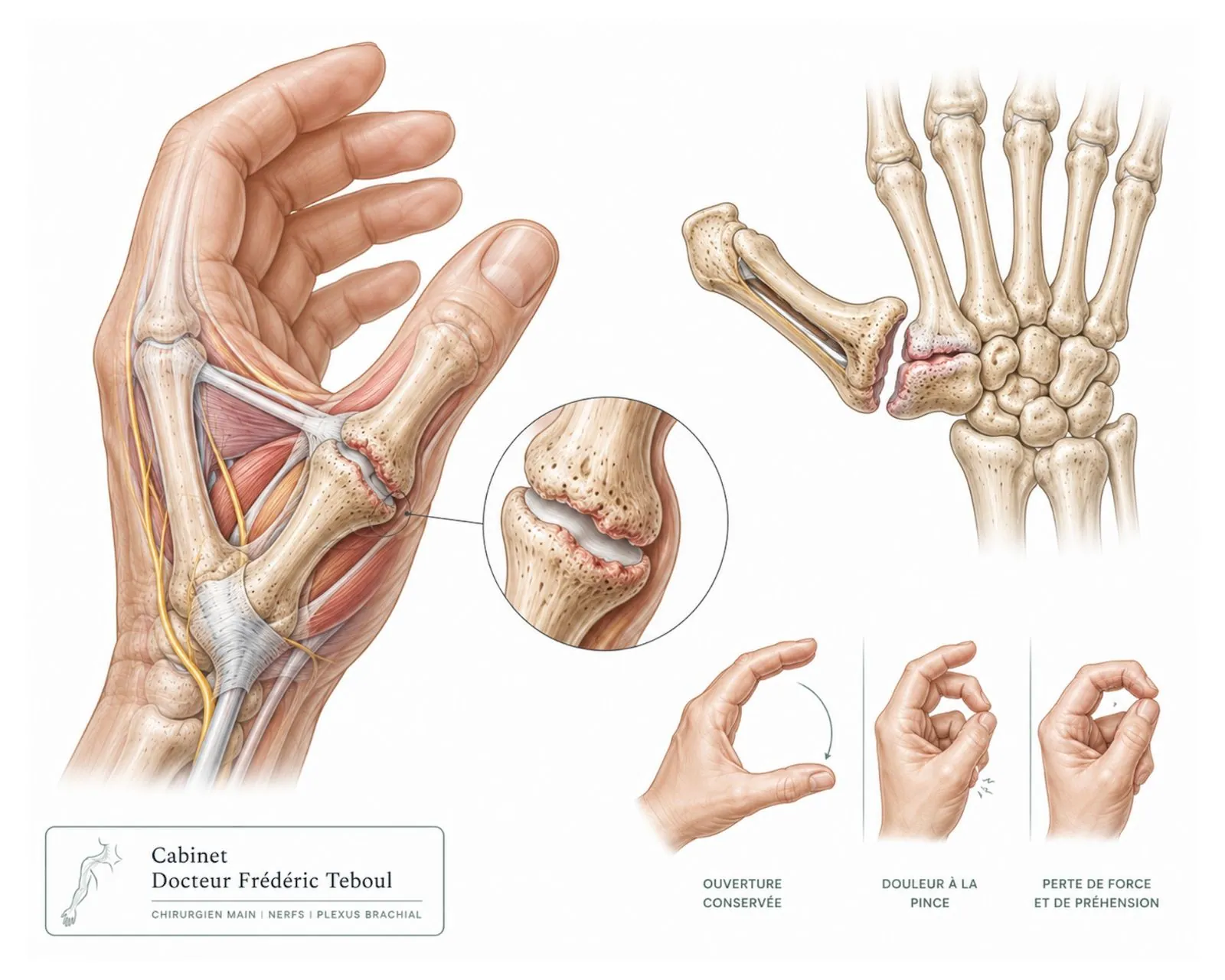
You can no longer open a jar. Turning a key makes you wince. The pain sits at the base of the thumb, just above the wrist, and it has been building for months.
Thumb-base osteoarthritis is one of the most common forms of osteoarthritis in the hand. It is also one of the most treatable — provided you know what each treatment can really offer. That is exactly what this article sets out, including where recent evidence contradicts what you usually read.
The most heavily used joint in your hand
The thumb connects to the wrist through a small joint called the trapeziometacarpal joint: it links a carpal bone, the trapezium, to the base of the first metacarpal.
Its shape is unusual — it is known as a “saddle” joint. This geometry gives it an exceptional range of motion: it is what lets the thumb oppose the fingers, and therefore pinch, and therefore do almost everything a human hand does.
This freedom comes at a cost. A joint this mobile is inherently unstable: its stability does not come from how the bones fit together, but from ligaments. When these ligaments stretch over time, the base of the metacarpal shifts slightly on the trapezium, stress concentrates on a narrower area, and the cartilage wears out faster.
It becomes a cycle: the wear worsens the instability, which worsens the wear. Understanding this makes it clear why the first treatment is to stabilize the joint rather than to rest it completely.
The signs that should prompt a consultation
The pain sits at the base of the thumb, on the outer edge of the wrist. It is mechanical: it appears with movement, not at rest, at least at first.
The movements that trigger it are always the same, and patients mention them without prompting:
Opening a jar or unscrewing a cap.
Turning a key in a lock.
Pinching a sheet of paper, a piece of fabric, a coin.
Writing or holding a pen for a long time.
Over time this is joined by a loss of strength, difficulty grasping bulky objects, stiffness, and sometimes cracking. At an advanced stage, the pain can occur at night.
What points to an advanced form
—A so-called “Z-shaped” deformity of the thumb: the base of the thumb folds in toward the palm while the next joint bends backward. The thumb loses its ability to open out.
—Being unable to spread the thumb far enough to grasp a large object.
—Visible muscle wasting at the base of the thumb.
These signs do not call for urgent action, but they indicate that the room for non-surgical treatment is narrowing.
Thumb-base osteoarthritis, carpal tunnel, trigger finger: why these three often go together
It is a consistent observation in hand surgery consultations: these three conditions affect the same profile of patients — women past their fifties — and often coexist in the same person. This matters for you. Pain at the base of the thumb together with nighttime tingling in the fingers points not to a single diagnosis but probably to two, which are treated differently. And a finger that catches on the same hand deserves to be examined at the same visit.
This is also why a specialist consultation examines the whole hand, and not just the spot that hurts.
The diagnosis — and why the X-ray does not tell the whole story
The clinical examination finds pain when the joint is pressed, limited thumb movement, and sometimes a catch or a perceptible shift at the base of the metacarpal.
Two maneuvers are used. The grinding test involves compressing the thumb along its axis while rotating it: it reproduces the pain and sometimes a grinding sensation. It is fairly specific but not very sensitive — in other words, a negative test does not rule out the diagnosis. A second test, moving the metacarpal sideways, appears to perform better.
The X-ray confirms and grades it: narrowing of the joint space, bone spurs, and hardening of the bone beneath the cartilage. The Eaton-Littler classification distinguishes four stages and is used in all clinical studies. Eaton 1987
The most important point in this section
The X-ray and the pain do not always match. Someone whose X-ray shows moderate osteoarthritis may have no symptoms at all. Another person, with exactly the same images, may be in pain and greatly limited day to day.
This is why thumb-base osteoarthritis is treated according to symptoms, not images. A worrying X-ray does not mean surgery is required; a reassuring X-ray does not rule out treatment.
Non-surgical treatments: what Europe recommends
The leading European recommendations for hand osteoarthritis set out a clear order. EULAR 2018
1. What comes first, before any medication
Education in ergonomic principles, pacing your activities, assistive devices, and exercises to improve function and muscle strength are the first steps of care, with or without a topical anti-inflammatory.
In practice: a jar opener, a key with a wide grip, a different way of carrying a bag. These are modest measures that, used together, genuinely change daily life.
2. The splint — and why it must be custom-made
Splints should be considered to relieve the symptoms of thumb-base osteoarthritis, and long-term use is recommended — this is the highest level of evidence in the entire recommendation.
Two details that change the outcome. The splint must be well fitted and custom-made by a specialized professional, and the need for a splint for thumb-base osteoarthritis is specifically cited as a reason to refer to a specialist. A splint bought at the pharmacy without a fitting does not have the same effect.
The recommended use is long-term, not limited to a few weeks. This is a point on which much of the information in circulation is inaccurate.
3. Medications
Topical treatments are preferred over systemic ones for safety reasons, and anti-inflammatory gels are the first choice.
Oral pain relievers, particularly anti-inflammatories, should be considered for a limited time.
Chondroitin sulfate may be used to relieve pain and improve function.
Disease-modifying antirheumatic drugs should not be used in hand osteoarthritis.
EULAR also advises against heat therapy, ultrasound, and hyaluronic acid injections.
4. Corticosteroid injections: a point to clarify
This is the most delicate topic in this article, and it deserves to be laid out plainly.
The European recommendations state that intra-articular corticosteroid injections should generally not be used in hand osteoarthritis. The exception considered concerns the finger joints, not the base of the thumb.
Yet injection of the trapeziometacarpal joint remains widely performed in France, and ultrasound guidance improves its accuracy. There is therefore a real gap between the recommendation and everyday practice. This gap deserves to be explained rather than passed over in silence.
Surgery: what it is for, and what it is not for
Surgery is considered when pain remains significant and disabling despite well-conducted non-surgical care, or in the face of advanced disease with deformity.
Read this before any decision
Surgery is judged effective at relieving pain, but not at improving function.
In other words: thumb-base osteoarthritis is operated on so the pain goes away. Some of the pinch strength may remain lower than it was, and the realistic goal is a hand that no longer hurts and that can handle everyday tasks — not the hand you had at thirty.
Setting this expectation correctly is what separates a satisfied patient from a disappointed one, with an identical surgical result.
The four families of techniques
A useful methodological point: the leading Cochrane review on the subject found no added benefit of one technique over another, whether for pain, function, the patient's overall assessment, strength, or complications. Cochrane 2015 Its literature search ends in 2013, however, which is why it does not cover the recent trials comparing the implant with trapeziectomy.
Trapeziectomy or implant? What the recent trials show
You still often read that implants should be avoided, with considerable loosening rates. That figure refers to first-generation implants and does not describe current data.
A double-blind randomized trial compared the two techniques in 62 women aged 40 and over, operated on for stage II or III osteoarthritis. At one year, the implant showed no superiority on the main functional score — but a significant advantage in strength and range of motion. de Jong 2023
A meta-analysis pooling four randomized trials and 420 participants refines the picture: at three months, the implant's advantage on pain may exceed the threshold of clinical relevance; at one year, that advantage has disappeared. The functional benefit is also temporary. The authors conclude that the implant may be preferable for people who value a fast recovery, while stressing that the available data cannot tell us whether it leads to more revision surgery in the long term.
In short: the implant allows a faster recovery and restores more strength and mobility, but the gap fades after a year. The uncertainty today concerns the implant's lifespan, not its effectiveness. The choice therefore depends on your age, your demands, and your tolerance for a longer recovery.
The risks
The complications described are residual pain, stiffness, instability, impingement between the structures of the thumb column, and complex regional pain syndrome. For implants there is the added risk of loosening and dislocation.
A useful finding from recent meta-analyses: the rate of complications rises with the complexity of the technique. This is one of the arguments that keep simple trapeziectomy in a strong position.
After the operation
Thumb-base osteoarthritis is the most frequently operated form of hand osteoarthritis.
The procedure is most often performed on an outpatient basis under regional anesthesia.
The patient is immobilized in a custom splint for a period that varies with the technique used (between 2 and 6 weeks).
Started as soon as the technique allows, it is a long process (between 3 and 12 months depending on the patient, the preoperative stage, pain tolerance, and any associated conditions).
To restore pain-free pinching between the thumb and fingers, without necessarily restoring normal function. Pinch strength between the thumb and fingers improves gradually over several months.
The two hands must never be operated on at the same time.
Returning to driving can be considered relatively early if the car is an automatic.
A particular point of caution: recovery after trapeziectomy is long — several months before strength returns.
What you can reasonably expect
Most patients who have surgery report significant, even complete, relief from pain, with a clear improvement in daily activities. Pinch strength often remains below its pre-operative levels.
This is consistent with what the European recommendations conclude: surgery relieves pain more than it improves function.
Frequently asked questions
Glossary
A small wrist bone at the base of the thumb, with which the first metacarpal forms a joint.
The joint affected in thumb-base osteoarthritis, between the trapezium and the first metacarpal.
A procedure that removes the trapezium, with or without ligament reconstruction or tendon interposition.
Permanent surgical locking of a joint.
A four-stage X-ray scale used to describe the progression of thumb-base osteoarthritis.
A deformity characteristic of advanced forms, combining a folding-in of the base of the thumb and overextension of the next joint.
References
Kloppenburg M, Kroon FPB, Blanco FJ, et al. 2018 update of the EULAR recommendations for the management of hand osteoarthritis. Ann Rheum Dis. 2019;78(1):16-24
Wajon A, Vinycomb T, Carr E, Edmunds I, Ada L. Surgery for thumb (trapeziometacarpal joint) osteoarthritis. Cochrane Database Syst Rev. 2015;(2):CD004631. PMID 25702783 (search ended August 2013)
de Jong TR, Bonhof-Jansen EE, Brink SM, de Wildt RP, van Uchelen JH, Werker PMN. Total joint arthroplasty versus trapeziectomy in the treatment of trapeziometacarpal joint arthritis: a randomized controlled trial. J Hand Surg Eur Vol. 2023;48(9):884-894. PMID 37459139
Seaourt AC, Dap F, Dautel G, et al. Comparison between the MAIA implant and trapeziectomy for trapeziometacarpal osteoarthritis: outcomes at 9 years' follow-up. J Hand Surg Asian Pac Vol. 2021;26:158-165
Guzzini M, Arioli L, Annibaldi A, et al. Interposition arthroplasty versus dual cup mobility prosthesis in treatment of trapeziometacarpal joint osteoarthritis: a prospective randomized study. Hand (N Y). 2024;19(8):1260-1268
Eaton RG, Glickel SZ. Trapeziometacarpal osteoarthritis. Staging as a rationale for treatment. Hand Clin. 1987;3:455-471
Page expanded, reviewed and approved by Dr Frédéric Teboul, surgeon of the hand, brachial plexus and peripheral nerves, member of the Académie Nationale de Chirurgie.
Last updated: 20 August 2026
Disclaimer. This article is for information only. It does not replace a medical consultation. Only a clinical examination can establish a diagnosis and choose a treatment suited to your situation.
Author of this article
Every piece of content is signed by its author and reviewed before publication.
 Author
Dr Frédéric Teboul
Hand surgeon — specialist in the brachial plexus and peripheral nerves
Author
Dr Frédéric Teboul
Hand surgeon — specialist in the brachial plexus and peripheral nerves