
Shoulder pain that makes it hard to raise your arm, get dressed, or sleep on your side. You've been told about a “rotator cuff tear,” and the word tear is unsettling — it suggests something broken, urgent, that needs fixing fast.
The reality is more nuanced, and far more reassuring in most cases. Everything depends on a simple question: is this a tendon torn by an accident, or a tendon worn down by time? These two situations share the same name but have neither the same meaning nor the same treatment.
The rotator cuff: what it does
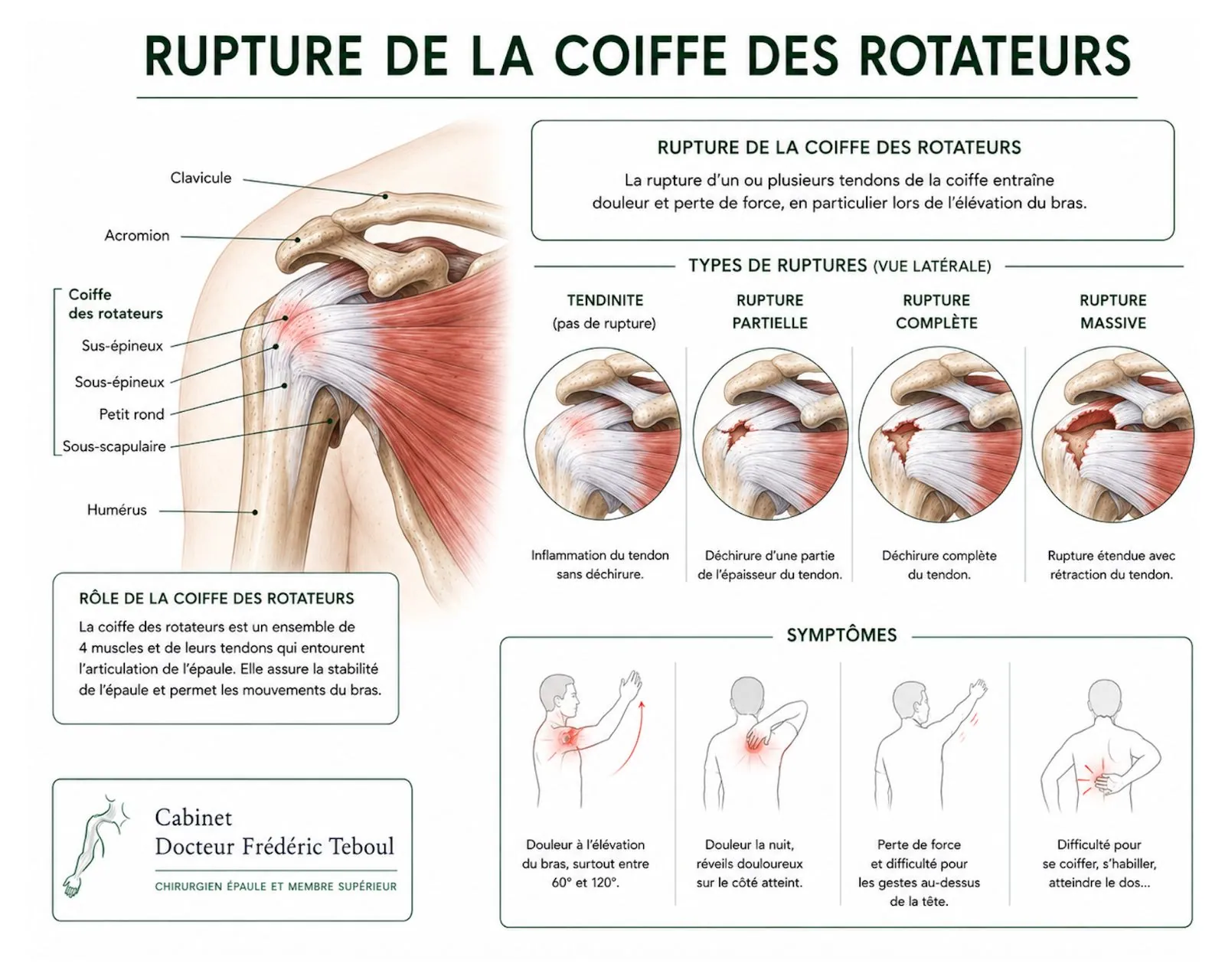
The shoulder is the most mobile joint in the body, and that mobility comes at a price: it sits in a shallow socket, so it depends heavily on the tendons and muscles that hold it. The rotator cuff is a group of four tendons that cap the top of the arm bone, like a hand placed over a ball.
Their role is twofold: they stabilize the head of the shoulder in its socket, and they let you raise and rotate the arm, especially above horizontal. That's why a problem with them mainly interferes with upward movements — reaching for something high, combing your hair, putting on a jacket.
Injury or wear: the distinction that changes everything
This is the heart of the article. Two very different situations hide behind the word “tear.”
The traumatic tear
It happens during a specific, identifiable event: a fall onto the arm or shoulder, a violent movement, a sudden pull, sometimes a shoulder dislocation. It tends to affect a relatively young person whose tendon was healthy before the accident.
The picture is often clear-cut: sudden pain, a marked and immediate loss of strength, sometimes an inability to raise the arm.
Degenerative tears
It is entirely different. The tendon wears down slowly, over years, with no triggering accident. It is an age-related phenomenon, extremely common, and often painless.
A fact that reframes the whole subject
Many rotator cuff tears don't hurt. Wear of the shoulder tendons increases with age to the point of becoming commonplace: studies show that a large share of people over 60 have a tear, and that this proportion exceeds half among those over 80 — often without knowing it, because there is no pain.
In other words, finding a tear on imaging does not necessarily mean it is the cause of the pain, or that it needs to be repaired.
Symptoms
The signs vary depending on whether it's an accident or wear, but you often find:
Shoulder pain, on the side or the top, sometimes radiating down the arm.
Night pain, triggered by lying on the affected shoulder — a very common and particularly bothersome sign.
Difficulty with overhead movements: combing your hair, reaching a shelf, getting dressed.
A loss of strength, more pronounced and more sudden in traumatic forms.
In the degenerative form, pain sets in gradually and may come and go. In the traumatic form, loss of strength is often front and center right from the accident.
Diagnosis
It combines the clinical exam and imaging:
The doctor tests mobility, the strength of the various cuff tendons, and tries to pinpoint the pain. This already points strongly toward a tendon problem versus another cause.
It doesn't show the tendons, but it does show the state of the joint and any indirect signs of long-standing wear.
It gives a good view of the cuff tendons and, in trained hands, detects a tear.
It clarifies the size of the tear, the degree of tendon retraction and the state of the muscle — factors that weigh heavily in the decision whether to repair.
What imaging must clarify, beyond simply “there's a tear”
Two elements matter as much as the existence of the tear, because they determine whether it can be repaired:
Tendon retraction: a torn tendon that has retracted far from its attachment is harder to repair.
Muscle quality: a muscle that has turned to fat over time — “fatty degeneration” — recovers poorly, even after repair. It is one of the main factors that lead to deciding against surgery.
Treatment depends first on the cause
This is where the injury / wear distinction becomes decisive, because it leads to two opposite approaches.
The traumatic tear in younger patients: repair, and fairly quickly
Faced with a true traumatic tear, in a young, active person whose tendon was healthy, the tendency is toward surgical repair, without too much delay.
The reason is mechanical: a torn tendon tends to retract over time, and the corresponding muscle to deteriorate. Repairing early, while the tendon can still be mobilized and the muscle is of good quality, offers the best chances. It's not an emergency of a few hours, but it's not a situation to let drag on for months either.
The degenerative tear: physical therapy first
For the wear form, the most common one, the logic reverses: non-surgical treatment comes first, and it is enough in a large share of cases.
What the studies show
For degenerative tears, several randomized trials have compared surgery with physical therapy. Their results converge: surgery does slightly better on pain and function at one year, but this difference stays below the threshold a patient actually notices.
In other words, for many wear-related tears, a well-run physical therapy program gives results comparable to surgery, while avoiding its risks and long recovery.
Physical therapy doesn't “repair” the tendon, but it teaches the neighboring muscles to compensate, reduces pain and restores much of the function. Pain relievers and, in some cases, an injection can help get through a painful spell and make physical therapy possible. Surgery remains up for discussion if the problem persists despite well-conducted physical therapy.
When surgery is chosen
When a repair is decided on, it is most often done arthroscopically — through small incisions and a camera — reattaching the tendon to the bone. Two points are worth knowing before deciding:
Recovery is long. It is measured in months, with initial immobilization followed by prolonged physical therapy. The result can't be judged for several months.
The repaired tendon doesn't always heal. There is a certain rate of re-tears, higher for large tears and poor-quality tendons. This is worth knowing before the procedure.
In very large, long-standing tears that can't be repaired, other solutions exist, up to a particular type of shoulder implant in advanced forms with osteoarthritis. These are beyond the scope of this article and call for a specialist shoulder opinion.
The big picture
This table sums up the message: before talking about repair, you need to know which kind of tear you're dealing with, and whether it's really the cause of the symptoms.
Recovery
Every case is different: visit our knowledge center to explore contextualized cases.
Frequently asked questions
Glossary
A group of four tendons that cap the top of the arm bone, stabilize the shoulder and allow the arm to raise and rotate.
A tear of a healthy tendon occurring during an accident, often in a young patient; repair fairly quickly.
Progressive age-related wear of the tendon, very common and often painless; physical therapy as first-line treatment.
The pulling back of a torn tendon far from its attachment, which makes repair harder over time.
Transformation of muscle into fat over time; a major factor in non-recovery, even after repair.
Surgery through small incisions using a camera, the usual technique for repairing the cuff.
References
Conservative management vs. surgical repair in degenerative rotator cuff tears: a systematic review and meta-analysis. Eur Rev Med Pharmacol Sci. 2021 — 7 trials, 326 patients: surgery is statistically superior at 1 year on pain and functional score, but without reaching the clinically meaningful difference
Conservative management of degenerative rotator cuff tears: systematic review of long-term outcomes. 2026 — 16 studies, 893 patients: conservative treatment gives results comparable to surgery in partial tears and in low-demand patients
Arthroscopic Repair Versus Conservative Treatment in Degenerative Cuff Tears. PMC12387239 — about 15-20% of people over 60 have a rotator cuff tear, more than 50% beyond 80; a high proportion bilateral and asymptomatic
Traumatic rotator cuff tears — current concepts. ScienceDirect. 2021 — early repair recommended for traumatic tears with low degeneration, to limit retraction and fatty degeneration
Natural History of Rotator Cuff Disease and Implications on Management. PMC4695395 — early repair recommended for acute traumatic tears in young patients; slow progression of degenerative tears when followed
Early versus delayed repair of traumatic rotator cuff tears. Eur J Orthop Surg Traumatol. 2021 — early repair: shorter recovery, less need for a graft in large tears
Healing and re-tear rates after arthroscopic repair by tear size
The role of the reverse implant in massive, non-repairable tears with osteoarthritis
Reviewed and approved by Dr Frédéric Teboul, hand, upper-limb and peripheral nerve surgeon, member of the Académie Nationale de Chirurgie.
Last updated: August 20, 2026
Disclaimer. This article is for information only. It does not replace a medical consultation. Shoulder pain or loss of strength, especially after an accident, deserves a specialist opinion.
Author of this publication
Every piece of content is signed by its author and reviewed before publication.
 Author
Dr Frédéric Teboul
Hand and upper-limb surgeon — peripheral nerves
Author
Dr Frédéric Teboul
Hand and upper-limb surgeon — peripheral nerves